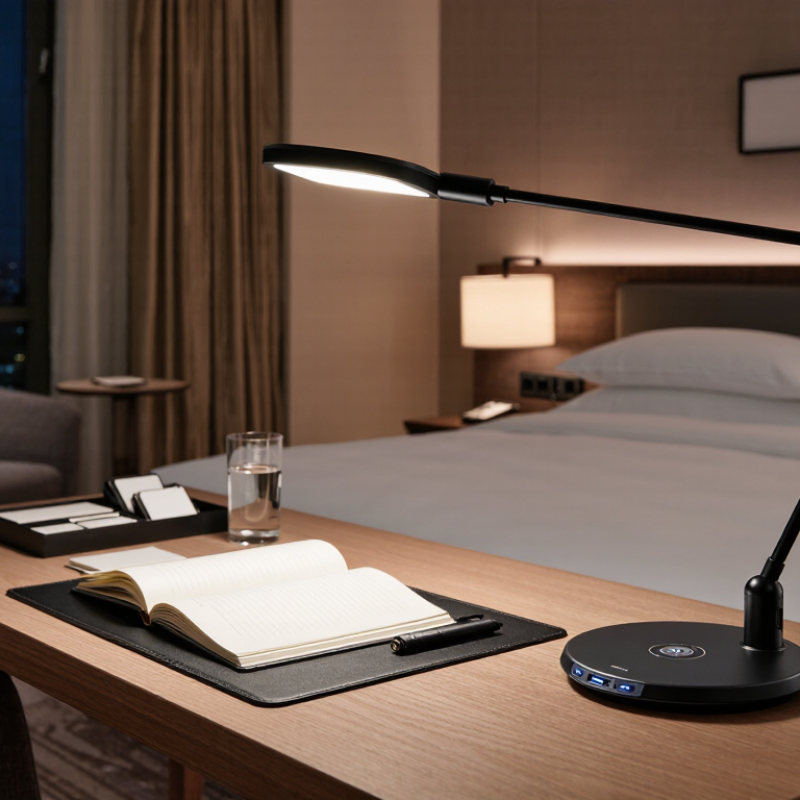
In 2026, the best Guestroom Desk Lamps will do more than brighten a work surface. They should help guests read, answer emails, or review travel plans without lighting the entire room. Richard Kelly, a pioneering lighting designer, described three elements of good lighting: “ambient luminescence, focal glow, and play of brilliants.” His framework remains useful when evaluating a desk lamp beside a hotel bed or worktable. The lamp needs focused light, but it should also feel comfortable within the room.
Look closely at practical details. Can a guest switch it on without searching behind the base? Does the shade direct light onto a notebook while limiting glare on a laptop screen? A stable base, accessible controls, and a replaceable light source can matter as much as appearance. Warm, even illumination often feels inviting; however, one color temperature will not suit every guest or every task. That is a real trade-off, not a design failure.
This guide considers light quality, durability, ease of cleaning, energy use, and how each fixture fits different room layouts. It also looks at touch controls, charging features, and compact designs, without assuming every added feature improves the guest experience. Some lamps look elegant in a showroom and feel awkward beside a narrow desk. That gap deserves attention. The right choice depends on the hotel’s rooms, maintenance needs, and guests—not just a product photograph.
Guestroom Desk Lamps: IES Task-Lighting Guidance of 300–500 Lux
What Are the Best Guestroom Desk Lamps for Hotels in 2026?
A useful guestroom desk lamp should make reading, writing, and laptop work comfortable without lighting the entire room. For the task area, a practical target is 300–500 lux, consistent with IES task-lighting guidance. Measure the light on the desktop, not beside the lamp or at eye level. A small lux meter can help verify the result after installation.
Guests use desks in different ways. A warm pool of light may suit a handwritten note, while detailed reading often benefits from brighter, even illumination. Choose a lamp with a shade or adjustable head that keeps the bulb out of direct view. Check for harsh reflections on laptop screens and glossy desks. Glare is easy to overlook during daytime checks.
Dimming helps guests adapt the light to late-night work or a quiet room. Still, dimming alone does not fix poor placement. Position the lamp so a guest’s writing hand does not cast a heavy shadow across the page. Test it from the chair, with a book and laptop on the desk. Small differences matter. There is no perfect setup for every guest, and a lamp that looks elegant may not perform well at the work surface.
Hotel Guestroom Desk Lamps: Task-Lighting Guidance
Reference points within the 300–500 lux recommended desk-task range
The chart illustrates the 300–500 lux task-lighting range stated in the guidance. The 400 lux value is the midpoint, not a separate measured result. Actual illuminance at the desk depends on the lamp, placement, and room conditions.
Hotel Lamp Types: DOE Says LEDs Use at Least 75% Less Energy
A guestroom desk lamp works hard in a small space. It lights paperwork, a laptop keyboard, and the corner where guests charge their phones. For hotels choosing lamps in 2026, energy use matters, but so does the quality of light. A harsh beam can make an otherwise comfortable desk unpleasant.
The U.S. Department of Energy says LEDs use at least 75% less energy than incandescent lighting. That comparison makes LED desk lamps an appealing option for rooms where lights may stay on for hours. Small choices matter. A well-made LED can also reduce how often staff replace bulbs, though actual lifespan depends on the product and how it is used. Check the lamp’s stated wattage, light output, and dimmer compatibility rather than assuming every LED performs equally.
Look for a stable base, an adjustable arm, and a shade that directs light onto the desk without shining into a guest’s eyes. A warm-white setting can feel calmer in the evening, while a separate task switch helps guests control the light easily. But comfort matters, too. I would not treat energy savings as proof that a lamp is pleasant; some LEDs still feel too cool or uneven. Testing a sample at desk height, with a book and laptop, can reveal problems that a product sheet misses.
2026 Selection Criteria: CRI 80+, Dimming, Glare Control, and USB-C
A hotel desk lamp should support both laptop work and a quiet evening, without making the room feel clinical.
For color accuracy, use a source rated CRI 80 or higher. That helps clothing, printed pages, and skin tones look more natural under the lamp. CRI is only a starting point, though; check samples beside the actual desk finish and wall colors.
Dimming matters when guests switch from typing to reading in bed. Look for smooth adjustment across the range, including a genuinely low setting, rather than a control that jumps from bright to nearly off. Glare control deserves equal attention. A shade or recessed diffuser should hide the direct light source from a seated guest, while still lighting a notebook evenly. Small details matter. A glossy desktop can reveal harsh reflections that seem minor in a showroom.
USB-C charging can reduce cable clutter, but verify the lamp’s stated output and test it with common guest devices. A port that charges slowly may disappoint someone working between meetings. Also check whether charging remains available when the light is dimmed or switched off. One limitation: specifications cannot predict every room’s feel. A practical mock-up at desk height, viewed from the chair and bed, can expose issues that a product sheet misses.
Compare Lifetime Value: DOE Reports LEDs Last Up to 25 Times Longer Than Incandescent Bulbs
For hotel guestroom desk lamps, lifetime value means more than the bulb’s purchase price. The U.S. Department of Energy’s Energy Saver guidance says LEDs can last up to 25 times longer than incandescent bulbs and use at least 75% less energy. That advantage can reduce replacement purchases and maintenance visits across many rooms. It is not a guarantee: actual life depends on operating hours, heat, and lamp design. A lamp used nightly beside a warm reading light may age differently from one used occasionally.
Consider the whole fixture, too. A sturdy base, stable shade, and accessible switch matter when housekeeping cleans desks each day. Fewer bulb changes can mean fewer interruptions for guests, but a poorly designed lamp can still fail early. A damaged socket or loose cord may outweigh the savings from a long-life LED. That detail is easy to miss. Compare expected service life, replacement-bulb availability, and warranty terms before ordering; the lowest upfront price may not be the lowest operating cost.
Tips: Choose a warm, comfortable light level for late-night reading. Check that staff can replace the bulb without special tools, and keep one compatible spare on-site. Track failures for a season; real room-use patterns may differ from estimates.
What Are the Best Guestroom Desk Lamps for Hotels in 2026? — Compare Lifetime Value: DOE Reports LEDs Last Up to 25 Times Longer Than Incandescent Bulbs
| Lamp option |
Typical light output |
Typical power use |
Typical rated life |
Estimated energy cost over 10 years |
Estimated replacements over 10 years |
Hotel suitability |
| LED desk lamp or LED bulb |
About 800 lumens |
About 9 watts |
About 25,000 hours for a representative long-life LED; product ratings vary |
About $39 |
Typically 0–1 during the modeled period |
Best overall lifetime value: low energy use, long rated life, and less frequent relamping. |
| Compact fluorescent (CFL) bulb |
About 800 lumens |
About 13–15 watts |
Commonly about 8,000–10,000 hours |
About $57–$66 |
Typically about 2–3 bulbs |
Can use less energy than incandescent, but generally needs more frequent replacement than a long-life LED. |
| Incandescent bulb |
About 800 lumens |
About 60 watts |
Commonly about 1,000 hours |
About $263 |
Typically about 29 bulbs |
Usually the least attractive option for frequent-use hotel rooms because of higher energy use and frequent replacement. |
Method and source: Energy estimates assume one lamp operating 8 hours per day for 10 years, electricity at $0.15 per kWh, and the wattages shown; they exclude purchase, labor, and disposal costs. Replacement counts are approximate and based on rated life, so actual results depend on operating hours, product quality, and conditions. The U.S. Department of Energy states that residential LED bulbs can last up to 25 times longer than incandescent bulbs. For hotel procurement, compare lumen output, color temperature, glare control, dimming compatibility, warranty, and replaceability.
Conclusion
Choosing the best Guestroom Desk Lamps for hotels in 2026 means balancing comfortable task lighting, energy efficiency, and practical features. Aim for illumination in the 300–500 lux range for desk activities, while using glare control to help guests work or read comfortably. LED lamps are a strong option because they use at least 75% less energy than incandescent lighting, according to the figures in the outline.
When comparing models, look for a color rendering index of 80 or higher, dimming capability, and convenient USB-C charging. Confirm that each lamp has an appropriate UL or ETL listing and meets applicable local electrical codes. Consider lifetime value as well as the initial purchase price: LEDs can last up to 25 times longer than incandescent bulbs, which may reduce replacement needs over time. Together, these criteria can help hotels select desk lighting that is useful, comfortable, and efficient for guests.