
Buying Fandelier Fixtures across borders requires more than choosing an attractive finish. A bronze frame may look elegant online, yet its true scale can overwhelm a compact dining room. Global buyers must compare airflow, light output, motor performance, voltage, ceiling height, and installation requirements. Small specifications matter.
This guide shares ten practical buying tips drawn from common sourcing and installation considerations. It explains how to review supplier experience, product drawings, warranty terms, sample quality, packaging strength, and after-sales support. Buyers should request clear measurements, wiring details, energy information, and relevant test reports before placing large orders. Certification requirements can differ between destination markets, so independent verification remains important.
A reliable supplier should answer technical questions directly and provide consistent documents. Ask how each Fandelier Fixtures model is tested before shipment. Request photographs of cartons, protective foam, mounting hardware, and finished assemblies. These details can reveal risks that polished product images hide. Do not rely on price alone.
No checklist is flawless. A buyer may overlook local electrician requirements or underestimate replacement-part costs. That mistake can delay an entire project. Careful communication reduces surprises, but it cannot remove every uncertainty. The most dependable decisions combine product evidence, supplier references, realistic delivery planning, and professional installation advice. With a measured approach, buyers can select fixtures that balance visual appeal, safety, performance, and long-term value across different markets.
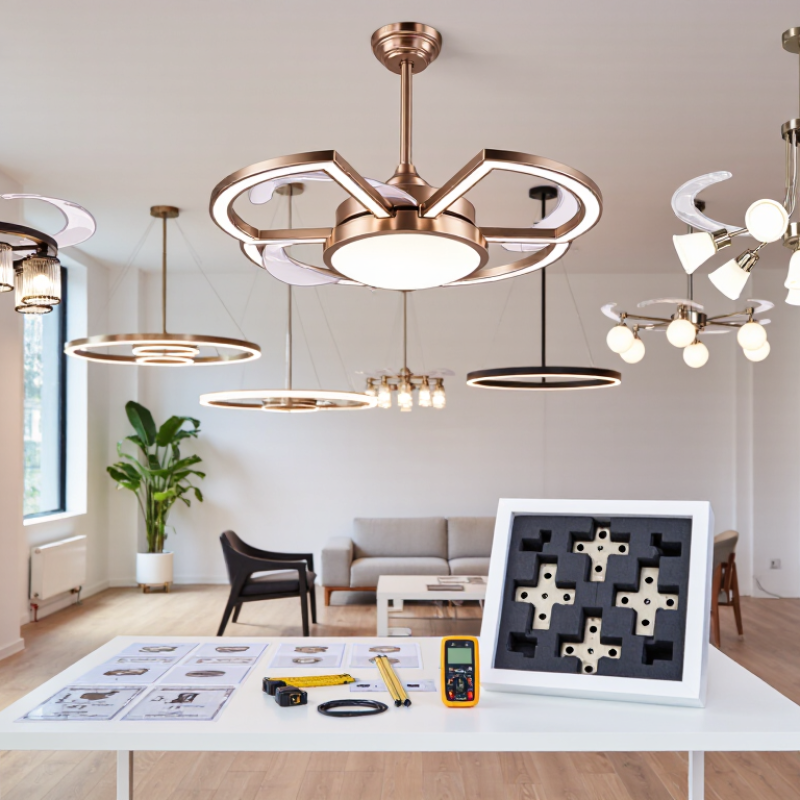
Before choosing a fandelier, define how the room should feel and function. Is it mainly for cooling, lighting, or both? A dining room may need focused downward light. A bedroom often benefits from softer, quieter airflow.
Measure the installation space carefully. Record ceiling height, room length, and the table or bed position. Leave safe clearance between the blades and nearby walls, cabinets, or tall doors. For low ceilings, choose a compact mounting design. For sloped ceilings, confirm whether an angled adapter is included or required. Small details matter.
Check the electrical conditions before ordering internationally. Confirm the local voltage, frequency, wiring method, and available ceiling box. A qualified electrician should verify load capacity and grounding. Do not assume a universal fitting. It may not be. Also check the control system, because remote controls and wall switches may not suit every installation.
Light output should match the room, not only the fixture’s appearance. Compare lumens, color temperature, dimming range, and shade material. Warm light can soften a lounge, while neutral light may suit a kitchen workspace. Consider motor noise in quiet rooms. I once underestimated blade width in a narrow dining area; the airflow felt strong, but the visual scale was wrong. Rechecking the room from several viewpoints would have prevented that mistake. A simple floor plan, ceiling photo, and installation sketch can save time and reduce costly changes.
| No. | Buying Dimension | What to Define | Practical Specification or Calculation | Installation and Purchasing Check |
|---|---|---|---|---|
| 1 | Room Size | Match the fandelier to the room area and ceiling height. | Measure room length × width. For many residential rooms, a fan diameter of approximately 42–52 inches suits medium spaces of about 100–400 square feet, subject to the product’s airflow rating. | Avoid selecting by appearance alone. Confirm the manufacturer’s recommended room area, airflow, and minimum ceiling-height requirements before ordering. |
| 2 | Ceiling Height and Downrod | Determine whether the fixture can maintain safe clearance from the floor and ceiling. | For typical residential use, the fan blades should generally be at least 7 feet above the floor. Low-profile mounts suit lower ceilings, while downrods are used for higher ceilings. | Record finished floor-to-ceiling height, the total fixture drop, and blade-to-floor clearance. Check whether an angled-ceiling adapter is required. |
| 3 | Lighting Level | Define whether the fixture is decorative, ambient, task-supporting, or the main room light. | Estimate lumens according to room use. A general residential starting point is roughly 10–20 lumens per square foot, with higher levels needed for kitchens, work areas, or darker finishes. | Check total delivered lumens rather than LED wattage. Confirm whether the light output is dimmable and whether the diffuser produces even illumination. |
| 4 | Color Temperature and Color Quality | Select the visual atmosphere and color-rendering performance required for the space. | Approximately 2700–3000 K creates a warm appearance; around 3500–4100 K is more neutral. An LED color-rendering index of 80 or higher is commonly suitable for general residential use. | For kitchens, dining areas, or retail-like interiors, consider higher color quality. Verify whether the fixture offers fixed, selectable, or adjustable color temperature. |
| 5 | Airflow and Energy Use | Balance cooling performance, operating noise, and electricity consumption. | Compare airflow in cubic feet per minute and efficiency in cubic feet per minute per watt. Higher airflow is not automatically better if the room is small or the fixture is noisy. | Request airflow, power input, standby consumption, speed settings, and noise data. Use comparable test conditions when evaluating products from different markets. |
| 6 | Electrical Compatibility | Confirm compatibility with the destination country’s electrical system. | Verify rated voltage, frequency, current, and wiring configuration. Common systems include approximately 100–127 V or 220–240 V, with frequency varying by market. | Do not rely on a plug adapter for voltage conversion. Check local installation rules, grounding requirements, controller compatibility, and certification documentation. |
| 7 | Ceiling Structure and Mounting | Identify the structural support available at the installation point. | The mounting box and support system must be rated for the combined weight and dynamic movement of a ceiling fan fixture, not merely for a stationary light. | Inspect joists, concrete anchors, suspended ceilings, and existing junction boxes. A qualified electrician should approve the support method before installation. |
| 8 | Control Method | Decide how users will control fan speed and light output. | Options may include a wall control, handheld remote, pull chain, or smart control. Light dimming and fan-speed control may require separate compatible circuits. | Confirm memory function, remote frequency, receiver location, battery type, smart-home requirements, and whether the control system is approved for the destination market. |
| 9 | Blade Clearance and Room Layout | Ensure the rotating blades will not conflict with walls, doors, cabinets, lights, or tall furniture. | Measure the fan’s full blade span and keep practical clearance from walls and nearby obstructions. The exact clearance depends on the installation guide and local safety requirements. | Mark the proposed fan center on the ceiling and check door swings, bunk beds, shelves, pendant lights, and air-conditioning outlets before purchase. |
| 10 | Maintenance, Packaging, and Compliance | Evaluate long-term serviceability and international shipment requirements. | Prioritize replaceable light modules or drivers, accessible filters and blades, clear manuals, spare fasteners, and securely protected glass or acrylic components. | Confirm installation instructions, spare-part availability, warranty terms, carton dimensions, gross weight, drop-test protection, labeling, and applicable electrical or safety compliance documents. |
Drum shades provide soft, even light for bedrooms and dining areas. Open cages look lighter but collect dust quickly. Attractive is not always practical.
A 42-inch fixture may suit a compact bedroom. Larger living rooms often need 52 to 60 inches. These sizes are only starting points.
Often, yes. Wider blades can move air quietly at lower speed. However, oversized blades may create uneven airflow in narrow rooms.
Compare cubic feet per minute, noise ratings, blade pitch, and motor control. Do not judge performance from speed alone. Test several settings.
Reverse rotation supports seasonal comfort. It can redistribute air without creating the same cooling effect. Room height still affects performance.
Confirm voltage, frequency, wall-switch compatibility, remote functions, and certified electrical components. Request measured performance data when specifications seem incomplete.
Compare wattage, motor efficiency, and airflow together. A low-wattage fixture is not efficient if it moves little air. Check standby power, too.
Choose accessible blades, removable light covers, standard fasteners, and documented replacement parts. Clean dusty blade edges with a soft, dry cloth every few months.
Request clear wiring diagrams and test dimming, speed, and timer functions. Keep safe clearance from walls, doors, and cabinets. I have trusted attractive specifications before, and regretted it.
Choosing the right Fandelier Fixtures begins with understanding your lighting goals, room dimensions, ceiling height, and installation conditions. Consider whether the fixture is intended for a bedroom, living area, office, or commercial space, then compare styles, blade sizes, light coverage, airflow performance, and noise levels. A well-matched design should provide both comfortable illumination and effective air circulation without overwhelming the room.
Before purchasing, examine the materials, motor construction, load capacity, and relevant safety certifications. Energy-efficient lighting and motors can reduce operating costs, while adjustable controls, remote access, and smart functions may improve daily convenience. Also review cleaning, replacement parts, and routine maintenance requirements. For international orders, confirm packaging quality, shipping arrangements, voltage compatibility, installation instructions, warranty terms, and after-sales support. A dependable supplier should clearly explain compliance documentation, delivery responsibilities, and service procedures, helping global buyers select durable, safe, and practical Fandelier Fixtures with greater confidence.