
Public Area Lighting in 2026 is not one fixture category. It is a set of choices shaped by site use, layout, and maintenance needs. A neighborhood street may need LED streetlights with controlled forward distribution. A wide plaza may call for area or flood lights mounted on taller poles. Along garden paths, low bollards can mark edges without dominating the view. Different jobs, different fixtures.
This guide compares common options, including pedestrian-scale poles, solar and hybrid systems, and connected lighting with dimming controls. It considers practical details: pole height, beam spread, glare, color appearance, and how easily crews can service each unit. A bright fitting is not automatically a good fitting. The details matter. Poor placement can leave dark patches beside an overlit entrance, while excessive glare can make a space less comfortable. Solar units may suit some paths, but shade, winter daylight, and battery replacement deserve attention. No single type wins everywhere. That is the useful, slightly inconvenient truth.
The best choice starts with observing how people actually use a place after dark. Note where they walk, wait, cross, and gather. Then compare the lighting design with the site’s needs, rather than choosing by appearance alone. Product specifications and qualified design advice can help verify performance; real conditions still matter. Even a careful plan may need adjustment once installed. This overview offers a grounded starting point for choosing safer, more welcoming public spaces in 2026.
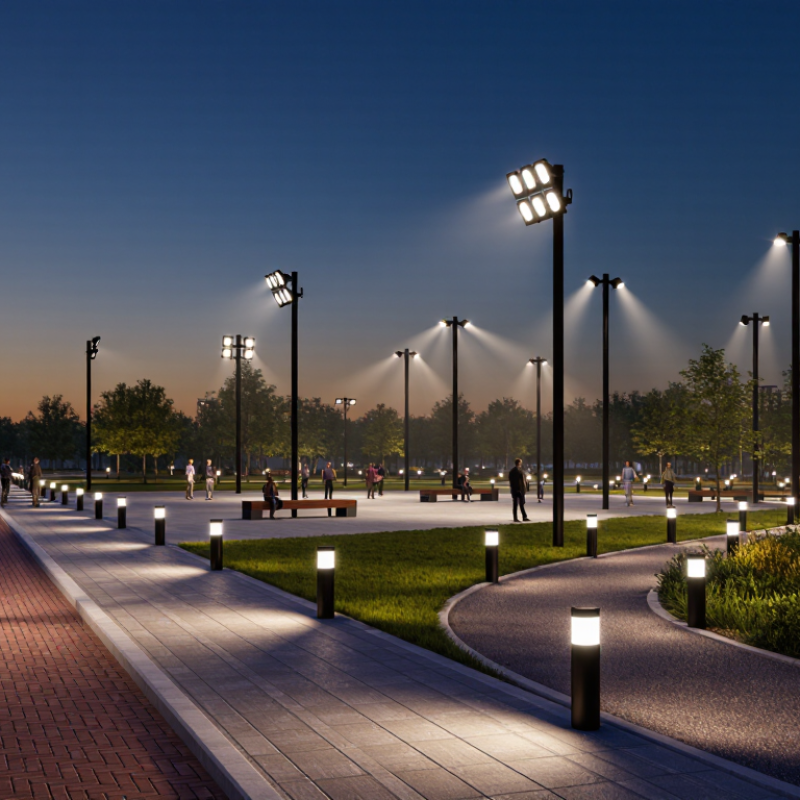
In 2026, public area lighting is best classified by where people move, what they need to see, and how light is distributed. Roadway lighting serves vehicle lanes and intersections; pedestrian lighting covers sidewalks, parks, and paths. Parking areas, transit stops, and civic plazas form separate use cases because their sightlines and activity patterns differ. Different places, different needs.
A second classification describes the beam. IES roadway practice recognizes distribution patterns from Type I through Type V, ranging from narrow paths to broad areas. Designers also consider mounting height, spacing, glare, and vertical visibility. A pole lighting a crosswalk needs to reveal people, not merely brighten pavement. That distinction is easy to miss.
Technology and controls add another layer: LED sources, dimming, occupancy response, and scheduled output can be specified for each site. The U.S. Department of Energy’s 2020 U.S. Lighting Market Characterization estimated LEDs represented about 48% of installed lighting stock, showing how widely the technology had spread. Yet classification alone does not guarantee comfort. A bright plaza can still produce harsh shadows or spill light toward nearby windows. The report describes the U.S. market, so its figures should not be treated as a global measure. In practice, a useful schedule names the area type, optical distribution, mounting conditions, and control strategy together. Often, the weak point is the handoff between them.
Public pedestrian areas can be classified by lighting class. This chart compares the maintained average horizontal illuminance levels specified for EN 13201 P1–P6 classes.
Values are minimum maintained average illuminance targets in lux: P1 15, P2 10, P3 7.5, P4 5, P5 3, and P6 2. The appropriate class depends on the area’s use and risk assessment; local requirements may differ. P7 is not shown because the standard does not specify an average-illuminance value for that class.
Roadway and street lighting must help drivers read the road without washing out signs or shining into nearby homes. A sound layout considers lane width, mounting height, pole spacing, and the beam pattern of each fixture. On wet pavement, reflections can make bright patches feel harsher while leaving darker gaps between poles. That detail matters. More light is not always better.
In 2026, many projects use efficient LED luminaires with carefully selected optics and dimming controls. The right output depends on the route: a residential street needs a different balance from a busy junction or multi-lane road. At crossings and intersections, consistent illumination can help reveal pedestrians, turning vehicles, and changes in road direction. Designers should review photometric plans, then check actual conditions after installation. Trees grow, signs move, and real streets rarely match drawings perfectly. Aiming errors can create glare, even when the fixture itself is suitable. One missed shadow near a crossing may deserve more attention than a higher wattage rating.
Public-area lighting in 2026 should help people read a space, not simply make it brighter. Pedestrian-scale poles work well at entrances and crossings, where faces and curb edges need clear visibility. In parks, shielded area lights can illuminate gathering spaces while limiting glare toward nearby homes. Along paths, carefully spaced poles or low-level fixtures help reveal bends, steps, and uneven paving. Small details matter.
The National Highway Traffic Safety Administration’s 2022 Traffic Safety Facts: Pedestrians reports that about three-quarters of pedestrian fatalities occurred in dark conditions. That figure concerns roadways, not park paths, so it should not be treated as direct proof that more park lighting prevents injuries. Still, it underscores why visibility deserves attention. ANSI/IES RP-8-22 offers professional guidance on roadway and parking-facility lighting, including visibility and uniformity; designers can use its principles carefully when assessing shared spaces.
A useful layout avoids bright pools separated by black gaps. Check the route at eye level, including where trees, benches, or signs cast shadows. Shielded optics can reduce glare, while warmer, lower-output lighting may help limit disturbance to wildlife. The trade-off is real: dimmer light can leave faces harder to recognize, and brighter light can feel harsh. Even a careful plan may miss a shadow that appears only after leaves grow in. Walk the site at night, then adjust.
Parking lots need broad, even light that helps drivers spot pedestrians, parked cars, and painted lines. Pole-mounted area lights are a common choice because their spacing and aiming can cover large paved areas. The right layout depends on pole height, fixture optics, and nearby buildings. More light is not always better. Poorly aimed fixtures can create glare or bright patches while leaving darker spaces between poles. A photometric plan can reveal these gaps before installation.
Plazas need a different balance. Pole lights can brighten open routes, while lower bollard lights help mark paths, steps, and planting edges. Shielded fixtures reduce light spilling into nearby windows. On a plaza, the warm pool near a bench should not become a harsh spotlight. Designers should check how trees, signs, and seasonal changes affect visibility. Even careful plans can miss how a space feels at night.
Transit areas combine movement and waiting. Canopy lighting helps passengers read signs and see boarding edges; poles can illuminate bus bays and access paths. At stations, lighting near entrances and ticket areas should support clear faces and visible information without shining into drivers’ eyes. Maintenance matters too: a failed fixture over a platform may leave a real gap. Site reviews after dark are useful, though they can expose flaws that are inconvenient to fix.
Compare public lighting by the task each space must support, not by brightness alone. LED streetlights suit roads and broad plazas because elevated optics can spread light across large surfaces. Check uniformity, glare, and vertical visibility near crossings, where faces and signs must remain legible. More lumens do not always mean safer streets. Poorly aimed fixtures can create bright patches beside dark pavement. Bollard lights mark paths and edges at pedestrian scale, but they rarely replace overhead lighting. Floodlights work for open courts or loading areas; narrow beams help limit spill beyond the target.
For parks, compare pole-mounted area lights with low-level path fixtures against actual tree cover and walking routes. Leaves can block a carefully planned beam. Solar units reduce trenching, yet output may vary with winter sun, shade, and battery condition. Grid-connected systems offer steadier operation and can support dimming schedules or motion-based controls. Evaluate maintenance access, corrosion resistance, and replacement intervals, especially near coastal air or road salt. Match pole spacing and mounting height to the fixture’s distribution curve, then verify coverage after installation. Plans are not enough. Check the edges. Look for dark gaps, glare at eye level, and light entering nearby windows. Measurements matter, but real use can expose flaws that a plan misses. Keep controls simple enough for maintenance staff to adjust and document.
| Lighting Type | Typical Placement | Performance Profile | Main Advantages | Key Considerations | Best-Fit Applications |
|---|---|---|---|---|---|
| LED Roadway Lighting | Roads, streets, bridges, and transport corridors; commonly mounted on poles along the route. | Designed to distribute light along the roadway and onto the pavement. LED sources support efficient operation and can be dimmed when paired with compatible controls. | Directional optics can limit wasted upward light; long service life can reduce relamping and maintenance needs compared with many older lamp technologies. | Optics, pole spacing, mounting height, glare, and light levels should be selected for the road layout and applicable standards. | Urban and suburban roads, residential streets, and arterial routes. |
| Solar LED Lighting | Locations where grid connection is difficult, costly, or unavailable; fixtures typically combine a solar panel, battery, controls, and LED luminaire. | Can operate independently of the electrical grid. Available operating hours and output depend on panel exposure, local solar conditions, battery capacity, and the lighting schedule. | Can avoid trenching and reduce dependence on grid power at suitable sites. | Battery autonomy, seasonal sunlight, shading, temperature, and battery replacement planning are important. Site conditions can affect reliability. | Remote paths, parks, parking areas, and selected low- or moderate-demand sites. |
| High-Mast Area Lighting | Large open spaces illuminated from tall poles, often with several luminaires aimed at different parts of the site. | Provides broad-area coverage from a small number of elevated mounting points. LED luminaires can be used to reduce energy use and simplify maintenance planning. | Can illuminate large sites while keeping poles and foundations away from some ground-level activities. | Requires careful aiming to manage glare and spill light. Access equipment or lowering systems may be needed for maintenance. | Large interchanges, ports, logistics yards, stadium surroundings, and expansive parking areas. |
| Pedestrian-Scale Path and Park Lighting | Walkways, plazas, campus paths, parks, and other pedestrian spaces; fixtures are usually mounted lower than roadway lights. | Supports visibility along paths and around pedestrian activity areas. Shielding and distribution should be matched to the path width and nearby surroundings. | Can provide more appropriately scaled lighting for pedestrians and help define routes and gathering areas. | Low mounting heights can create uneven light if spacing and optics are not coordinated. Avoid excessive brightness and light trespass near homes or wildlife-sensitive areas. | Public parks, promenades, civic spaces, and pedestrian connections. |
| LED Floodlighting | Building exteriors, monuments, public squares, outdoor work areas, and selected recreational spaces. | Projects light over a target area or surface. Beam angle, aiming, shielding, and mounting position determine coverage and spill. | Flexible aiming and a range of beam distributions make it suitable for many localized lighting tasks. | Misalignment can cause glare, unwanted light on neighboring properties, and sky glow. Use only the output and coverage required for the task. | Architectural features, public gathering areas, and task-specific outdoor zones. |
| Tunnel and Underpass Lighting | Road tunnels, underpasses, and enclosed or semi-enclosed vehicle routes. | Requires a coordinated lighting design that accounts for the change between exterior daylight and the tunnel interior. LED systems can support controlled output and staged operation. | Designed to support visibility through the transition into, through, and out of the tunnel. | Lighting levels and controls need to account for daylight, traffic conditions, maintenance access, and the tunnel’s geometry. | Road tunnels and underpasses where visibility and transitions in brightness are important. |
Performance depends on the luminaire, optics, installation, controls, site conditions, and maintenance plan. Confirm project requirements against applicable local lighting and road-safety standards.
It should reveal lane edges, signs, crossings, and changes in direction without creating glare. More light is not always better.
Water reflects bright areas, which can create harsh patches and darker gaps between poles. The road may look uneven.
Residential streets usually need a softer balance. Busy junctions and multi-lane roads may need clearer illumination around turning vehicles and crossings.
Poor aiming can send light toward drivers or nearby homes. Even a suitable fixture can cause trouble when positioned badly.
It should make pedestrians, parked cars, and painted lines easier to spot. Check for dark spaces between poles.
Pole lights can brighten open routes, while lower bollard lights mark steps and planting edges. A bench should not sit under a harsh spotlight.
Canopy lights help passengers read signs and see boarding edges. Poles can cover bus bays and access paths.
Trees grow, signs move, and drawings cannot capture every nighttime condition. A site review may reveal shadows near crossings or failed fixtures over platforms. Some fixes may be inconvenient.
Public Area Lighting in 2026 covers a range of lighting solutions designed to make shared outdoor spaces safer, more comfortable, and easier to navigate. Its main types include roadway and street lighting for vehicle routes, where clear visibility and consistent coverage are essential, and pedestrian, park, and pathway lighting, which helps people move through public spaces while supporting a welcoming atmosphere.
Parking lots, plazas, and transit areas have different needs, from illuminating broad open surfaces to highlighting entrances, waiting zones, and walking routes. To compare these lighting types, consider the space’s purpose, layout, typical users, visibility needs, energy use, and maintenance requirements. The best choice is not simply the brightest option; it is a well-matched solution that provides useful, even light and supports the way people use the area.