
0%

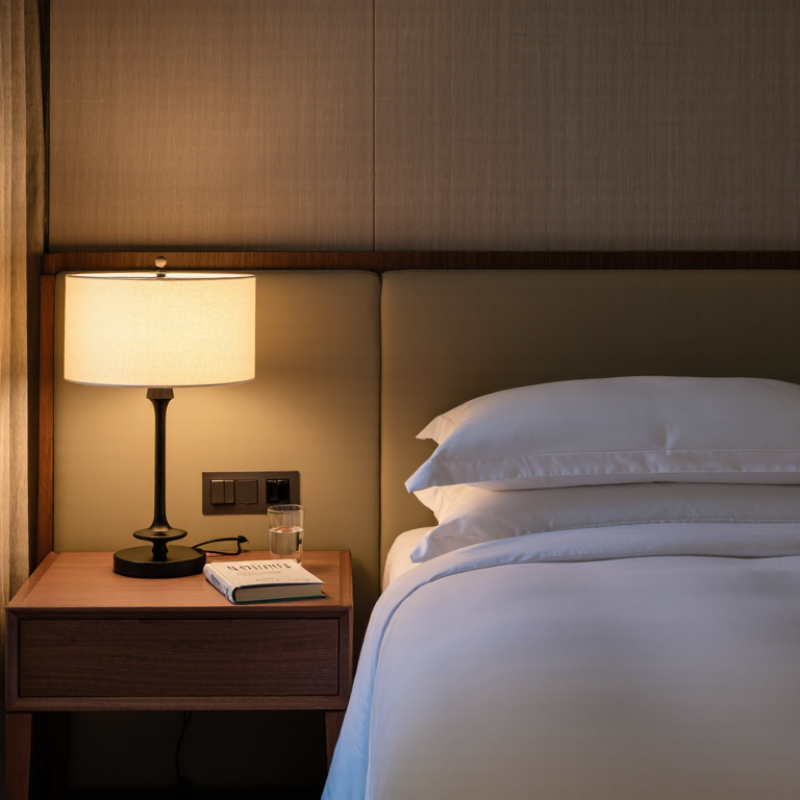
A guestroom nightstand lamp is more than a small light beside a bed. It gives guests a practical way to read, check the time, or find a glass of water without lighting the entire room. Its position, brightness, shade, and controls all affect how comfortable the bedside feels. At night, a switch that is easy to reach can matter as much as the lamp’s appearance.

Architectural lighting designer Richard Kelly described light as “the fourth dimension of architecture.” His idea offers a useful lens for understanding Guestroom Nightstand Lamps: they shape how a room feels, not just how clearly it can be seen. A warm pool of light on a paperback, a shaded glow across a headboard, and a reachable switch can make a hotel room feel more considered. Small details. Real impact.

Choosing a lamp still involves trade-offs. A compact base saves space, but it may feel unstable on a narrow table. A bright bulb helps with reading, yet can seem harsh when a guest is winding down. Design teams should consider the room’s layout, the lamp’s light output, and how easily guests can operate it. Those details deserve testing in the actual room, not only on a showroom table. Even a well-chosen lamp can miss the mark if its switch is hidden or its light falls directly into a guest’s eyes. This guide explains what a guestroom nightstand lamp is, which features matter, and how thoughtful selection can support comfort without adding visual clutter.

What Is a Guestroom Nightstand Lamp?

What a Guestroom Nightstand Lamp Is and How It Serves Guests

What Is a Guestroom Nightstand Lamp?

A guestroom nightstand lamp is a small light placed beside a bed, usually on a bedside table. It gives guests a convenient source of light without requiring them to cross a dark room. Unlike a ceiling fixture, it can be switched on from bed. That small detail matters after a late arrival or during an early morning.

A useful lamp has a stable base, an easy-to-reach switch, and a shade that softens direct glare. The light should make a book or phone screen visible without flooding the whole room. In practice, placement is as important as the lamp itself: leave enough table space for a glass of water, and keep the cord away from where it could snag. A switch on the base may be harder to find than one on the cord or bedside wall. Check it from the pillow.

Comfort varies. Some guests prefer a brighter reading light; others want a dim, quiet room. A warm-toned bulb can feel gentler at night, but it may not suit every task. There is no perfect setup. I’d reconsider any arrangement that looks polished in a photo but forces a guest to reach awkwardly or search for the switch in the dark.

What Is a Guestroom Nightstand Lamp?

A guestroom nightstand lamp is a bedside light that gives guests convenient, local lighting for reading and moving around at night. The chart shows illustrative illuminance planning ranges for common bedroom tasks; actual recommendations vary by design guidance, room conditions, and individual needs.

Lux (lx) measures illuminance on a surface. A nightstand lamp is most useful when it provides focused reading light while allowing a lower, comfortable light level for nighttime use.

Key Components: Base, Shade, Socket, Switch, and Bedside Controls

What Is a Guestroom Nightstand Lamp?

Key Components: Base, Shade, Socket, Switch, and Bedside Controls

A guestroom nightstand lamp is more than a small source of light. Its parts shape comfort, usability, and upkeep. A weighted base helps prevent tipping when a guest reaches across the table. It should fit the surface without crowding a phone, water glass, or book. Stability matters.

The shade softens bulb glare and directs light toward reading material. A fabric shade can feel warm, while a lighter inner lining may improve brightness. The socket must suit the intended bulb type and wattage; check the fixture label rather than guessing. A loose socket or flickering bulb deserves prompt attention. Small details matter.

The switch should be easy to find from bed, even in a dim room. A rotary switch, pull chain, or touch control can work, but consistency across rooms reduces confusion. Some nightstand setups pair the lamp with bedside controls, such as a panel for room lights or nearby charging outlets. Keep controls plainly labeled and within comfortable reach. Fancy controls can still frustrate. Guests may overlook a feature if it takes too long to understand. A simple test helps: sit on the bed, reach for the switch, and see whether it feels natural.

Light Output: Lumens, Lux, and a 300–500 Lux Reading Benchmark

A guestroom nightstand lamp should make reading comfortable without flooding the whole room with light. Lumens describe how much light a lamp emits; lux measures how much reaches a surface. They are related, but they are not interchangeable. A bulb’s lumen rating alone cannot tell you how bright a book will look beside the bed.

For reading, use 300–500 lux on the page as a practical benchmark, not a fixed rule. Measure where the book rests, with the lamp in its usual position and the room’s other lights set as they would be at night. A dark shade, a low bulb, or a lamp placed far from the mattress can reduce the light reaching the page. That matters. Comfort also depends on glare, contrast, and eyesight, so the same reading may feel too bright to one guest and dim to another. I would test the setup with an actual book; a phone light-meter app can offer a rough check, though it is not a precision instrument.

Tips: Choose a shaded, adjustable lamp and check the page at pillow height. If the light feels harsh, angle it away from the eyes rather than simply choosing a weaker bulb. Room lighting can change the result.

Color Quality: CRI 80+ and Warm 2,700–3,000 K Light

What Is a Guestroom Nightstand Lamp?

A guestroom nightstand lamp should make reading, settling in, and finding small items comfortable. Color quality matters as much as style. A color rendering index (CRI) of 80 or higher helps fabrics, books, and skin tones look more natural than they may under lower-CRI light. CRI does not measure brightness, so check the lamp’s light output separately.

Warm light between 2,700 and 3,000 K creates a relaxed evening feel without making a room look strongly orange. Around 2,700 K feels especially cozy; 3,000 K can appear a little clearer for reading. A shaded lamp can soften glare, though a shade that is too dark may leave the bedside table dim. Small details matter.

Tips: Check the bulb’s CRI and color temperature on its packaging. Try reading a few lines in the actual room, then adjust the lamp’s position. If colors seem dull, the bulb may need a higher CRI. A dimmer can help guests choose a comfortable level, but compatibility should be confirmed before installation.

Light also changes with wall color, shade material, and nearby windows. A warm bulb may look different beside cool gray paint than beside cream walls. There is no single setting that suits every guest. Review the room at night, when the lamp will do most of its work.

Hotel Selection: Safety Certification, LED Efficiency, and Easy Access

What Is a Guestroom Nightstand Lamp?

A guestroom nightstand lamp is a bedside light designed for reading, winding down, and finding essentials without crossing a dark room. Hotel selection starts with safety. Look for a recognized independent electrical-safety certification, such as UL or ETL listing, and check that the lamp’s voltage and bulb limits match the room’s supply. Inspect the cord, plug, and shade for damage before installation. A certification mark is useful, but it does not replace routine checks.

LED efficiency matters across hundreds of rooms. The U.S. Department of Energy reports that LEDs use at least 75% less energy and can last up to 25 times longer than incandescent lighting. ENERGY STAR guidance cites savings of up to 90% and lifespans up to 15 times longer. Figures differ by product and comparison method. Still, lower replacement frequency can reduce maintenance visits and interruptions for guests.

Easy access is practical, not decorative. Place the switch where a seated or lying guest can reach it, and keep the cord clear of walkways. A broad, stable base helps prevent knocks from bags or bedside items. Choose a shade that directs light onto a book without shining into the next bed. Touch controls can feel convenient, though guests may not immediately understand them. A simple switch may be less elegant, but clearer.

FAQS

What is a guestroom nightstand lamp?

It is a small bedside light guests can switch on without leaving the bed. Handy after a late arrival.

What features make a bedside lamp easy to use?

Look for a stable base, softened light, and a switch guests can reach from the pillow. Test the switch in a dim room.

How much table space should the lamp leave?

Leave room for a water glass, phone, or book. Keep the cord clear of places where it might snag.

What bulb color temperature feels comfortable at night?

Warm light around 2,700–3,000 K often feels calm. But one setting will not suit everyone.

What does a CRI of 80 or higher help with?

It can make book pages, fabrics, and skin tones look more natural. CRI does not tell you how bright the lamp is.

How can guests get enough light for reading?

Try reading a few lines beside the bed. A dark shade may leave the table too dim.

Are dimmers and touch controls always a good choice?

They can help, but guests may find unfamiliar controls frustrating. Check bulb and dimmer compatibility before installation.

What should be checked before a room is ready?

Sit on the bed and reach for the switch. Check for flickering, loose sockets, and awkward placement. Photos can miss these details.

Conclusion

A guestroom nightstand lamp is a bedside light designed to help hotel guests read, relax, and move around their room comfortably. Its main components include a stable base, a shade that directs or softens the light, a socket and bulb, and an easy-to-use switch. Some designs also place controls within convenient reach from the bed, making it simpler for guests to adjust the light without getting up.

When choosing Guestroom Nightstand Lamps, consider both brightness and light quality. Lumens describe the amount of light a lamp produces, while lux measures the light reaching a surface; around 300–500 lux can provide a useful reading level. A color rendering index of 80 or higher helps colors appear natural, and a warm color temperature of 2,700–3,000 K creates a relaxed atmosphere. Hotel selections should also prioritize appropriate safety certification, energy-efficient LED lighting, and straightforward access to switches and bedside controls.

Evelyn

Evelyn

Evelyn is a professional marketing specialist dedicated to helping businesses understand the value, applications, and practical benefits of the company’s products. With a strong knowledge of product features, industry trends, customer needs, and market communication, Evelyn creates clear,......