
Precision-engineered linear profiles, architectural pendants, and linkable task luminaires manufactured in OEM/ODM certified facilities.
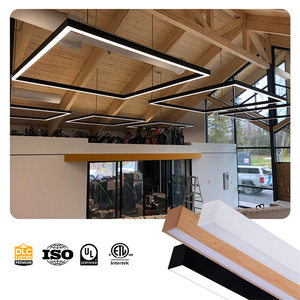
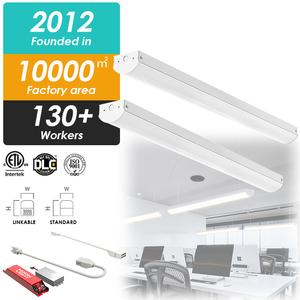
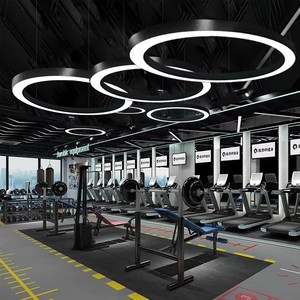
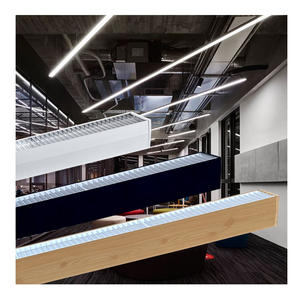
The global commercial real estate landscape is undergoing a structural paradigm shift toward WELL Building Standards, LEED v4.1 certification, and Human-Centric Lighting (HCL) integration. As enterprise architectural teams, commercial purchasing consortia, and interior design firms evaluate direct factory procurement in China, understanding the technical depth and manufacturing maturity of modern Chinese LED factories is critical to mitigating risk and maximizing project Return on Investment (ROI).
Leading Chinese office lighting manufacturers have evolved beyond low-cost component assembly into vertically integrated engineering powerhouses. Prime industrial hubs in Guangdong (Zhongshan, Shenzhen, Dongguan) and Zhejiang (Ningbo, Hangzhou) maintain end-to-end supply chains encompassing precision aluminum profile extrusion, automated Surface-Mount Technology (SMT) LED placement, high-transmission micro-prismatic lens fabrication, and rigorous photometric quality assurance testing (IES LM-79, LM-80, and TM-21 benchmarking).
Information Gain Insight: Sourcing direct from tier-1 Chinese factories provides specifiers with up to 40% CapEx savings while unlocking granular customization options—including custom extruded aluminum cross-sections, continuous quick-connect harness systems, and custom color-rendering profiles tuned to specific workspace finishes.
High-grade 6063-T5 aircraft aluminum profiles engineered with optimized thermal fins ensure LED junction temperatures remain below 65°C, eliminating thermal droop and extending lumen maintenance beyond 50,000 hours.
Multi-layer optical stacks incorporating micro-prismatic acrylic diffusers and glare-control louvers deliver uniform luminance, meeting strict EN 12464-1 visual comfort criteria for computer-intensive office tasks.
Pre-tested integration with global driver brands (Tridonic, Lifud, MeanWell, Philips Xitanium) supporting 0-10V, DALI-2 DT8, Triac, and wireless Bluetooth Mesh / Zigbee protocols without stroboscopic flicker.
When evaluating supplier bids for corporate headquarters, open-plan workspaces, or multi-tenant commercial retrofits, procurement teams must look beyond raw wattage and initial lumen output. The matrix below outlines the critical engineering criteria that distinguish spec-grade commercial luminaires from low-grade commodity fixtures:
| Performance Metric | Commercial Grade (Spec-Grade) | Commodity / Standard Grade | Engineering Impact on Office Workspace |
|---|---|---|---|
| Luminous Efficacy | 130 - 160 lm/W | 80 - 100 lm/W | Reduces long-term HVAC thermal loads and enterprise energy expenses by up to 35%. |
| Unified Glare Rating (UGR) | UGR < 16 to UGR < 19 | UGR > 22 to UGR > 25 | Prevents eye strain, fatigue, and headaches among employees, complying with OSHA and European visual health norms. |
| Color Quality & Consistency | CRI > 90 Ra / SDCM < 3 (MacAdam Ellipse) | CRI > 70-80 Ra / SDCM > 5 | Ensures true-to-life architectural material rendering and visual uniformity across vast floor plates. |
| Optical Distribution | Bi-Directional (70% Down / 30% Up) | 100% Direct Downward | Eliminates the "cave effect" by illuminating ceiling cavities, enhancing ambient space perception. |
| North American Compliance | UL / ETL Listed (Dry/Damp), Title 24 / JA8 | Uncertified or Basic CE Only | Passes municipal electrical inspections effortlessly and qualifies for regional utility energy rebates. |
The office lighting manufacturing industry in China is evolving rapidly under the dual drivers of smart building IoT expansion and circular economy mandates. Forward-thinking buyers are prioritizing four core technological developments when issuing RFPs to Chinese factories:
Integrating dual-channel LED engines capable of smooth color temperature shifts from 2700K (warm relaxing light) to 6500K (energizing daylight) controlled via DALI-2 DT8, synchronized with human circadian rhythms to boost workplace focus and occupant well-being.
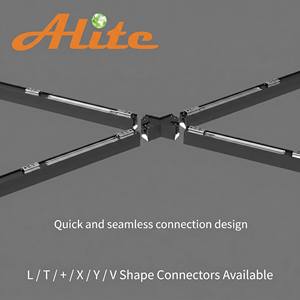
Contractors are demanding toolless mechanical connectors and plug-and-play wiring harnesses. Modern linear systems feature snap-in light modules and pre-wired quick couplers that cut job-site installation labor hours by over 50%.
Leading factories are adopting recycled post-consumer aluminum profiles, halogen-free wiring, and replaceable LED light engines and driver pods. This modular design strategy supports simplified maintenance and facilitates post-service recycling.
Clear answers to common technical, logistics, and compliance queries raised by B2B buyers, wholesalers, and general contractors.
For North America, hardwired linear lights and suspended pendants must carry either UL (Underwriters Laboratories) or ETL (Intertek) certification marks listed under UL 1598 (Luminaires) and UL 8750 (LED Equipment). For California installations, compliance with Title 20 and Title 24 / JA8 energy efficiency rules is mandatory. For European Union imports, CE-LVD (Low Voltage Directive), CE-EMC, RoHS, and ERP energy efficiency compliance are required. Reputable Chinese OEMs provide complete test reports and listing numbers prior to purchase order confirmation.
Tier-1 factories source LED chips directly from top-tier packagers (such as Samsung, Bridgelux, CREE, or Honglitronic) under strict 3-step MacAdam Ellipse (SDCM < 3) binning guarantees. This ensures that every fixture installed across a 20-story building displays identical color temperature without visible shifts or chromatic variance.
Standard architectural linear profiles typically carry an MOQ of 50 to 100 units for stock anodized finishes (black, white, silver). Fully customized extrusion dies or bespoke powder-coat colors may require an MOQ of 300 to 500 meters. Standard production lead times run between 15 to 25 calendar days after sample approval and deposit receipt.
Yes. Established commercial lighting suppliers maintain in-house darkrooms equipped with integrating spheres and goniophotometer testing systems. They supply validated .IES and .LDT photometric data files, allowing lighting designers and engineers to model lux levels, uniformities, and UGR ratings accurately in Dialux software before ordering.
Extruded aluminum profiles are wrapped in protective PE anti-scratch film, fitted with custom-cut EPE foam end-caps, and packed into reinforced 5-ply honeycomb corrugated cartons. For long 8-foot (2.4m) continuous profile sections, wooden pallet cradles or plywood crate enclosures are utilized to eliminate bending risks during container transit.
Consult with our senior optical engineers and commercial sales directors for free photometric calculations, custom OEM sample prototyping, and bulk factory quotation packages.